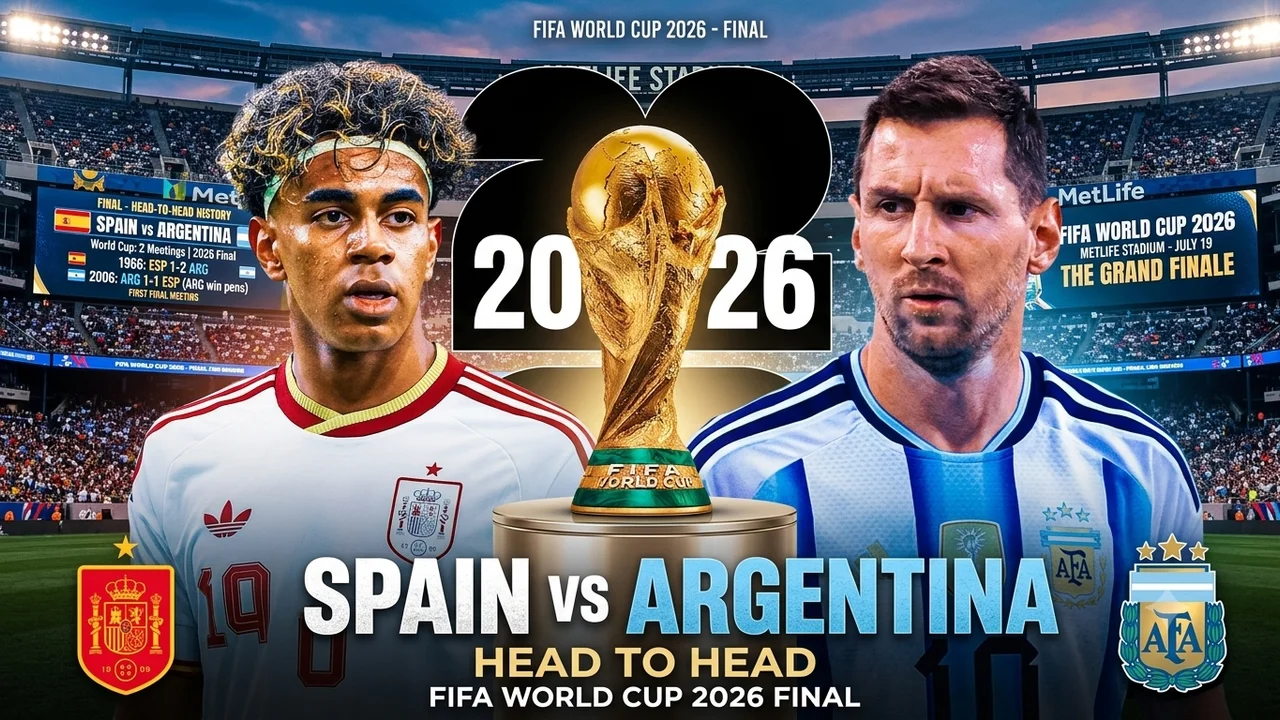
Spain Win FIFA World Cup 2026 After Dramatic Extra-Time Victory Over Argentina


Spain Are World Champions
Spain are champions of the world once again.
La Roja defeated defending champions Argentina 1–0 after extra time in the 2026 FIFA World Cup Final at New York New Jersey Stadium in East Rutherford, securing the country’s second men’s World Cup title and its first since the unforgettable triumph of 2010.
It was a final shaped by Spanish control, Argentine resistance, a late red card and a decisive extra-time breakthrough. Spain dominated possession and created nearly all the meaningful attacking opportunities, but Argentina goalkeeper Emiliano Martínez produced an outstanding performance to keep the contest scoreless throughout regulation time.
Argentina’s task became even more difficult when Enzo Fernández was dismissed near the end of the opening 90 minutes. Spain eventually made their numerical and territorial superiority count in extra time, scoring the only goal of a tense final before protecting their advantage until the last whistle.
The victory completes a remarkable tournament for Spain and confirms the arrival of another golden generation.
Spain vs Argentina Final Score
- Competition: FIFA World Cup 2026 Final
- Date: July 19, 2026
- Venue: New York New Jersey Stadium, East Rutherford, New Jersey
- Result after 90 minutes: Spain 0–0 Argentina
- Result after extra time: Spain 1–0 Argentina
- World champions: Spain
Spain lifted the trophy after a demanding final in which Argentina defended heroically but struggled to create opportunities at the opposite end of the pitch.
Spain Are World Champions for the Second Time
Sixteen years after Andrés Iniesta’s extra-time winner against the Netherlands delivered Spain’s first World Cup, La Roja have returned to the top of international football.
The 2026 title carries a different identity from the victory of 2010, but the foundations remain familiar: intelligent possession, technical excellence, patience and complete belief in a clear footballing philosophy.
Spain entered the tournament among the strongest teams in world football. Their combination of established stars and fearless young players allowed them to control matches without becoming predictable.
Against Argentina, Spain were required to demonstrate more than technical quality. They needed patience, emotional control and the courage to continue attacking after being repeatedly denied.
They showed all three.

A Final Controlled by Spain
From the opening stages, Spain attempted to impose their rhythm.
They circulated the ball across the defense, used the midfield to draw Argentina out of position and repeatedly looked for space in wide areas. Argentina remained compact, protected the central zones and placed their faith in counterattacks and the goalkeeping of Emiliano Martínez.
Spain’s territorial advantage became clearer as the game progressed.
Argentina struggled to sustain possession and were pushed deeper toward their own penalty area. Spain continued creating shooting opportunities, although Martínez refused to be beaten during regulation time.
By the end of the opening 90 minutes, Spain had registered 15 attempts while Argentina had failed to record a shot. Martínez made 10 saves, a record for a men’s World Cup Final, to carry his team into extra time.
Despite their dominance, Spain never appeared frustrated enough to abandon their game plan. They continued moving the ball patiently and waited for the decisive opening.
Emiliano Martínez Keeps Argentina Alive
Argentina would not have reached extra time without a remarkable performance from Emiliano Martínez.
The goalkeeper produced save after save as Spain increased the pressure. He denied efforts from distance, reacted sharply inside the penalty area and organized the defenders positioned in front of him.
Martínez’s most important intervention during regulation time came late in the match when he stopped a powerful Lamine Yamal free kick.
His performance gave Argentina hope that the final could reach penalties, where the goalkeeper’s reputation and confidence would have made the defending champions dangerous.
For long periods, it appeared that Martínez might produce another heroic chapter in Argentina’s World Cup story. Spain, however, continued searching for the goal rather than allowing thoughts of a shootout to take control.
Enzo Fernández’s Red Card Changes the Final
The balance of the contest shifted decisively during stoppage time at the end of regulation.
Enzo Fernández received a second yellow card following a challenge on Pau Cubarsí, reducing Argentina to 10 men just before extra time began.
Argentina had already spent most of the game defending deep. Losing a midfielder made it even more difficult to protect the spaces around the penalty area while maintaining any threat on the counterattack.
Spain immediately recognized the opportunity.
Their full-backs moved higher, the midfield circulated possession more aggressively and Argentina were forced into an increasingly narrow defensive block.
The South American champions continued battling with extraordinary determination, but playing extra time against Spain with one fewer player eventually proved too demanding.
Spain Find the Extra-Time Breakthrough
After being denied for more than 90 minutes, Spain finally scored during extra time.
The goal was the reward for sustained pressure rather than a sudden change in approach. Spain continued shifting Argentina’s defensive shape from side to side, waiting for fatigue and the numerical disadvantage to create an opening.
When the breakthrough arrived, the Spanish bench erupted and the thousands of La Roja supporters inside the stadium realized their team was within touching distance of the trophy.
Argentina attempted to respond, but their attacking options were limited. With 10 players and tired legs, they struggled to move enough bodies forward without leaving spaces for Spain to exploit.
Spain managed the remaining minutes intelligently, kept possession whenever possible and prevented Argentina from building a sustained final attack.
When the referee brought the contest to an end, Spain’s players dropped to the pitch in celebration.
They were world champions.
Spain End Argentina’s Title Defence
Argentina arrived in the final hoping to become the first nation since Brazil in 1962 to retain the men’s World Cup.
Their run to the championship match had demonstrated the same resilience that defined their victory in Qatar four years earlier. They survived difficult knockout matches, recovered from setbacks and found crucial goals under pressure.
Spain, however, prevented Argentina from controlling the final.
Lionel Messi was forced to drop deeper to find possession, while Argentina’s forwards became increasingly isolated. Without sustained control in midfield, the defending champions could not create the type of moments that had carried them through previous rounds.
The defeat ends Argentina’s reign as world champions and denies the country a fourth men’s World Cup title.
It was a painful conclusion for a team that defended with enormous commitment, particularly after going down to 10 men.
Lionel Messi Falls Short in Another World Cup Final
Much of the pre-match attention focused on Lionel Messi and the possibility that the final could be his last appearance at a World Cup.
Messi had already completed football by leading Argentina to glory in 2022. Four years later, he returned to the biggest stage and helped guide his country into another final.
Spain’s structure, however, made it difficult for him to influence the match in advanced positions.
Whenever Messi received the ball, Spain closed the surrounding spaces quickly. He often had to move into deeper areas to participate in possession, leaving Argentina without enough attacking support around the Spanish penalty box.
The defeat does not reduce his extraordinary international legacy, but it brings an emotional end to Argentina’s attempt to defend the trophy.
Lamine Yamal Completes a Remarkable Rise
For Spain, the triumph represents another historic step in Lamine Yamal’s extraordinary career.
The young winger entered the World Cup as one of football’s brightest stars and left it as a world champion.
Throughout the tournament, Yamal provided width, creativity and unpredictability. His confidence in one-on-one situations forced opponents to adjust their defensive plans, often creating valuable space for Spain’s midfielders and other attackers.
In the final, he came close to scoring from a late free kick, only to be denied by Martínez.
Even without scoring the decisive goal, Yamal’s influence remained central to Spain’s attacking identity. His World Cup victory further strengthens the belief that he will be one of the defining players of his generation.

Spain’s Midfield Wins the Tactical Battle
Spain’s greatest strength throughout the final was their control of midfield.
They dictated where the game was played, recovered possession quickly and prevented Argentina from building attacks through the center.
Rodri provided calmness and positional security, while Spain’s more advanced midfielders continually moved between Argentina’s defensive lines. Their ability to receive the ball under pressure prevented the match from becoming chaotic.
That control became particularly important after Argentina were reduced to 10 players.
Spain resisted the temptation to force every attack. They remained patient, trusted their movement and continued creating pressure until the decisive chance arrived.
It was a performance built on technical superiority but completed by maturity.
Spain’s Road to the 2026 World Cup Trophy
Spain’s route through the knockout rounds demonstrated the variety within this team.
They could dominate weaker opponents, survive tight matches and defeat elite European rivals.
Round of 32: Spain 3–0 Austria
Spain opened their knockout campaign with a commanding victory over Austria.
They controlled the match from the beginning, created chances consistently and advanced without conceding.
Round of 16: Spain 1–0 Portugal
The Iberian rivalry produced a much tighter contest.
Spain demonstrated patience and defensive concentration, scoring the game’s only goal and preventing Portugal from finding an equalizer.
Quarterfinal: Spain 2–1 Belgium
Belgium provided one of Spain’s strongest challenges of the tournament.
La Roja were tested defensively but responded with enough attacking quality to reach the semifinal.
Semifinal: Spain 2–0 France
Spain delivered one of their most complete performances against France.
They controlled the semifinal, scored twice and kept a clean sheet against one of the tournament’s strongest attacking teams.
Final: Spain 1–0 Argentina After Extra Time
The final required patience, courage and physical endurance.
Spain dominated but were repeatedly denied by Martínez. Argentina’s red card increased the pressure, and Spain eventually scored in extra time before successfully defending the advantage.
Five knockout matches, five victories and only one goal conceded: Spain’s route to the trophy was worthy of a world champion.
Argentina’s Road to the Final
Argentina’s tournament was defined by dramatic matches and late victories.
Round of 32: Argentina 3–2 Cape Verde
Argentina survived a five-goal contest in their opening knockout match.
Round of 16: Argentina 3–2 Egypt
Another difficult match ended with Argentina scoring three times and advancing.
Quarterfinal: Argentina 3–1 Switzerland
Argentina produced a more controlled performance to reach the last four.
Semifinal: Argentina 2–1 England
The defending champions overcame England in a dramatic semifinal to book their place against Spain.
Final: Spain 1–0 Argentina After Extra Time
Argentina defended with determination but could not overcome Spain’s possession, attacking pressure and numerical advantage.
Why Spain Deserved to Win
World Cup finals are not always won by the team that controls possession or creates the most chances. On this occasion, however, Spain’s superiority was clear.
They deserved the victory because they:
- Controlled possession and territory
- Produced nearly all the attacking opportunities
- Remained patient after repeated saves
- Prevented Argentina from registering a meaningful attacking threat
- Used their numerical advantage intelligently
- Maintained concentration after taking the lead
- Stayed committed to their footballing identity
Argentina’s defensive effort deserves enormous respect, particularly after Enzo Fernández’s dismissal. But Spain were the team consistently trying to decide the match through attacking football.
Their extra-time goal provided a fair conclusion to a performance built on authority and persistence.
Spain Complete a New Golden Era
The World Cup triumph confirms an extraordinary period for Spanish football.
Spain’s success is not based on one player or one fortunate tournament. It reflects years of youth development, tactical education and a national commitment to technically intelligent football.
The squad combines players at different stages of their careers.
Experienced leaders provide calmness and structure. Younger stars bring speed, fearlessness and creativity. Together, they have created a side capable of dominating possession while also competing physically and defending with discipline.
Spain’s first golden generation won Euro 2008, the 2010 World Cup and Euro 2012.
The current team now has the opportunity to build a similarly powerful legacy.
Spain Join the Two-Time World Cup Winners
Spain’s victory places a second star above the national team badge.
Their men’s World Cup titles are now:
- 2010: Spain defeated the Netherlands 1–0 after extra time
- 2026: Spain defeated Argentina 1–0 after extra time
Both triumphs were secured in tense finals that remained scoreless after 90 minutes.
Both were decided by a single Spanish goal in extra time.
That remarkable similarity will forever connect the generations of 2010 and 2026.
Celebrations Begin Across Spain
The final whistle triggered celebrations inside the stadium and across Spain.
Supporters gathered in major cities and public viewing areas to watch La Roja compete for their second world title. When the match ended, streets filled with Spanish flags, songs and emotional celebrations.
For older supporters, the victory brought back memories of 2010.
For a younger generation, it created a defining football moment of their own.
The players celebrated together on the field before preparing to lift the World Cup trophy. Argentina’s footballers, exhausted and disappointed, remained nearby as Spain’s name was added to the list of champions.
It was the final image of a tournament Spain had controlled from the knockout stage to the decisive whistle.
Key Moments from Spain vs Argentina
Spain Control the Opening Stages
Spain dominate possession and push Argentina into a deep defensive shape.
Martínez Denies Spain
The Argentina goalkeeper produces a series of saves to keep the score level.
Regulation Ends 0–0
Despite Spain’s pressure and 15 attempts, neither team scores during the opening 90 minutes.
Enzo Fernández Sent Off
The Argentina midfielder receives a second yellow card during stoppage time, leaving his team with 10 players before extra time.
Spain Score in Extra Time
La Roja finally break Argentina’s resistance and move within minutes of the championship.
Full Time After Extra Time
Spain protect their one-goal advantage and are crowned FIFA World Cup champions.
Spain vs Argentina Match Summary
Spain approached the final with the intention of controlling the ball and forcing Argentina to defend for extended periods.
That plan worked almost immediately.
Argentina’s defensive line remained compact, but the team could not consistently escape Spain’s pressure. Martínez kept the score level with a historic goalkeeping display, while Spain continued attacking without losing their tactical discipline.
The dismissal of Enzo Fernández changed Argentina’s chances significantly.
Spain used the additional player to stretch the defending champions and eventually scored during extra time. Argentina attempted to find a late equalizer, but Spain controlled the closing stages and secured the trophy.
The final score was narrow.
The overall performance was decisive.
Frequently Asked Questions
Final Thoughts
Spain are world champions again.
Their 1–0 extra-time victory over Argentina was the final reward for a tournament built on technical brilliance, tactical control and belief.
Argentina defended with courage. Emiliano Martínez produced a performance that almost carried the defending champions to penalties. Even after Enzo Fernández’s red card, they continued fighting until the final whistle.
Spain, however, refused to be denied.
They dominated possession, created the chances and continued attacking until the decisive goal arrived. Once ahead, they showed the composure required to complete the job.
Sixteen years after their first triumph, Spain have returned to the summit of world football.
The generation of 2010 is no longer alone.
Spain’s stars of 2026 have written their own history—and La Roja now have a second World Cup trophy.